 dpow
dpowWhat dpow.app saves a design manager: the cost benefit, with the sums
For fit-out, M&E, joinery and partitions contractors who deliver packages for main contractors. dpow.app does not replace your design manager. It makes your design team faster and more consistent. It sets each project up from the contract pack, keeps the registers running, flags risks and variations, logs every action by who and when, and writes the weekly report. The time it gives back goes on design, or on another project.
Published figures are named with their source where they appear. Figures described as our estimate are dpow's own; each is set out with its basis so you can test it against your own business, and the calculator below does the sums with your numbers.
The film: More design, less paperwork
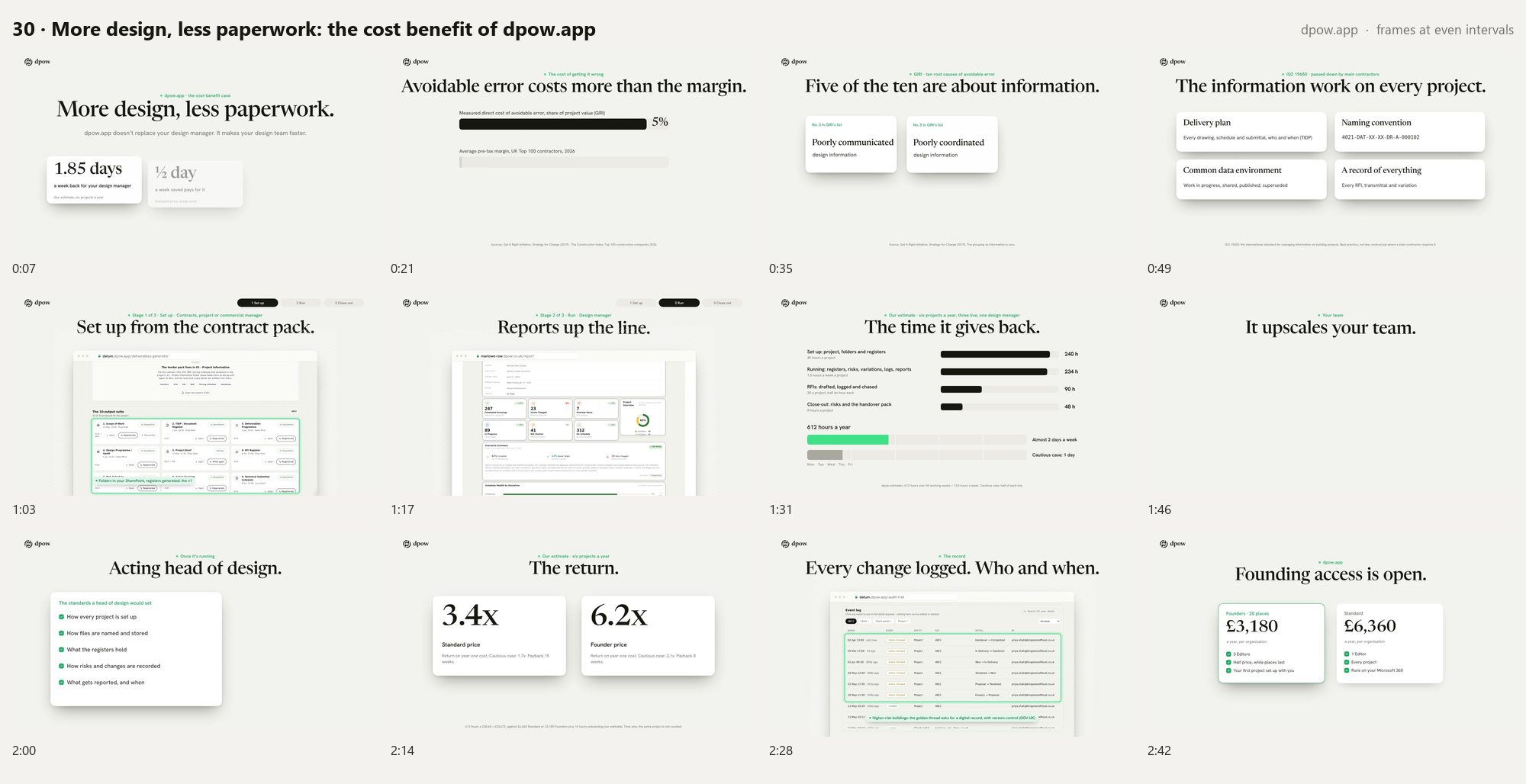
2 minutes 50 seconds, with voice-over. Real dpow.app screens with an invented cast. Contact sheet: 12 frames at even intervals, with timestamps.
What the film shows, in words
- 0:03 More design, less paperwork. dpow.app doesn't replace your design manager; it makes your design team faster. 1.85 days a week back (our estimate); half a day a week pays for it; 3.4x return.
- 0:11 Avoidable error costs more than the margin. The measured direct cost of avoidable error is about 5% of project value (GIRI, 2019), against an average pre-tax margin of just over 3% for the UK Top 100 contractors and 3.33% for the top 20 specialists (The Construction Index, 2026).
- 0:30 Five of the ten are about information. Of GIRI's ten root causes of error, five are about how information moves between people (the grouping is ours).
- 0:39 The information work on every project. What main contractors pass down under ISO 19650: a delivery plan (TIDP), a naming convention, a common data environment, a record of every RFI, transmittal and variation. None of it is the work you priced.
- 0:54 Three stages. Set up from the contract pack (folders in your SharePoint, the registers, the v1); run to handover with registers kept live, risks and variations flagged, every action logged and reports up the line; close out with risks closed and the handover pack complete.
- 1:24 The time it gives back. 612 hours a year across six projects (our estimate): set-up 240, running 234, RFIs 90, close-out 48. Almost two days a week; one day in the cautious case.
- 1:33 More design, or another project. £23,672 of a design manager's time a year, or about £50,000 pre-tax profit on one more £1.5m project.
- 1:45 It upscales your team, junior to senior, and 1:55 acts as head of design: the standards a head of design would set (roles advertised at £80,000 to £110,000).
- 2:08 The return. 3.4x at the Standard price, 6.2x at the founder price; payback in 15 and 8 weeks. 2:16 It pays for itself at 4.1 hours a week (Standard) or 2.2 hours (Founders), whatever our estimates.
- 2:24 Every change logged, who and when: the audit trail, the kind of record the golden thread asks for on a higher-risk building. 2:32 One way of working, to best practice. Founding access is open: Founders £3,180 a year, Standard £6,360.
1. Avoidable error costs more than the margin
The Get It Right Initiative (GIRI) is a UK industry body set up to reduce avoidable error in construction; its members include major contractors such as Balfour Beatty, Kier and Skanska, professional bodies and public clients. In its Strategy for Change (revised June 2019), GIRI reports that international studies put the measured direct cost of avoidable errors at about 5% of project value, around £5 billion a year across UK construction. Once unmeasured and indirect costs are included, GIRI gives estimates of between 10% and 25% of project cost.
The Construction Index Top 100 for 2026, ranked by turnover from filed accounts and compiled with Company Watch, shows the 100 largest UK contractors turning over a combined £81 billion for £2.3 billion pre-tax profit: an average margin of just over 3%. The top 20 specialist contractors averaged 3.33%.
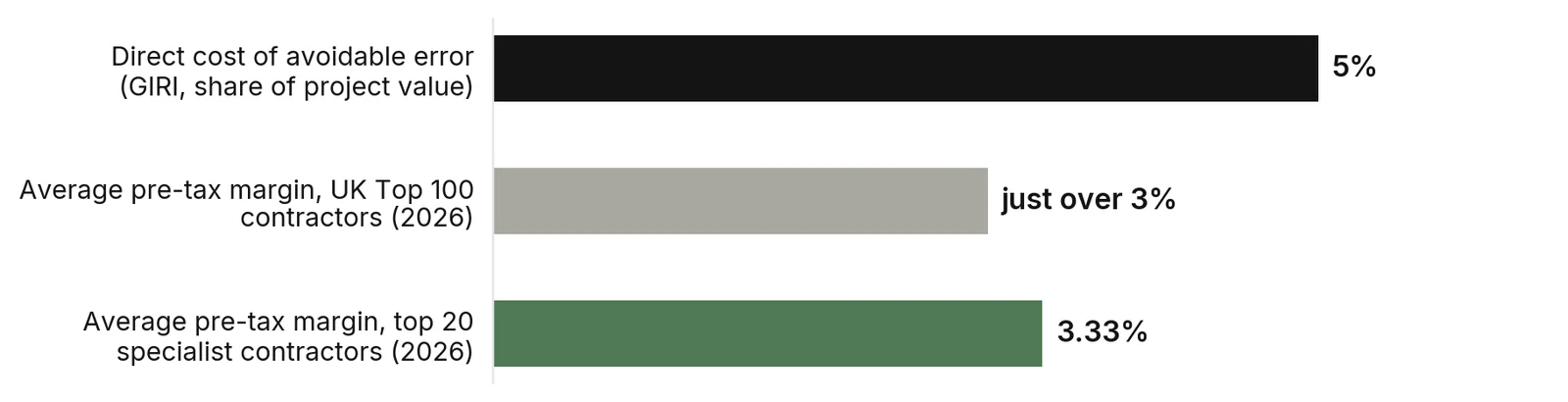
On these figures the measured cost of avoidable error alone is larger than the margin. Smaller specialists are not in these figures and margins vary by firm, but the point holds: the cost of getting it wrong is of the same order as the profit, so even a small reduction in error is worth a great deal.
Where error comes from
GIRI lists ten root causes of avoidable error. In our reading, five of them are about information and how it moves between people, rather than workmanship:
| No. | Root cause (GIRI) | What it looks like on a package |
|---|---|---|
| 2 | Late design changes | A revised drawing arrives after work has been set out or made |
| 3 | Poorly communicated design information | The current revision sits in someone's inbox, not where the team works |
| 5 | Poorly coordinated design information | Your drawings and the services, ceiling or structure drawings disagree |
| 8 | Poor interface management and design | Nobody owns the junction between your package and the next trade |
| 9 | Ineffective communication between team members | Questions are asked by phone and never written down |
When it ends in a dispute, the record matters. King's College London, reporting with the Adjudication Society in November 2024, found UK adjudication referrals at a record 2,264 in a year, and named the leading causes as inadequate contract administration and lack of competence of project participants.
2. The information work on every project
Main contractors may pass down information requirements based on ISO 19650, the international standard for managing information on building projects. It is best practice rather than law, but where a main contractor requires it, it becomes part of your contract.
| Requirement | What it means for you |
|---|---|
| Information requirements and execution plan | What information you must deliver, in what format and by when, and your plan for doing it |
| Task Information Delivery Plan (TIDP) | Every drawing, schedule and submittal you will produce, who produces it and when it is due |
| Naming convention | Every file named to the project's code, for example 4021-DAT-XX-XX-DR-A-000102 |
| Common data environment (CDE) | Files held in agreed states: work in progress, shared, published, and archived |
| RFIs, transmittals and variations | A written record of every question asked, every document issued and every change agreed |
| Handover | Operation and maintenance information and as-built records, indexed and complete |
Without a common system each manager builds their own: one keeps the register in a spreadsheet, another in a notebook; file names, folders and reports change from job to job. Each job starts from a blank folder, nobody else can pick it up when someone is away, and the business has no single view of what is late or at risk.
3. How dpow.app runs a project
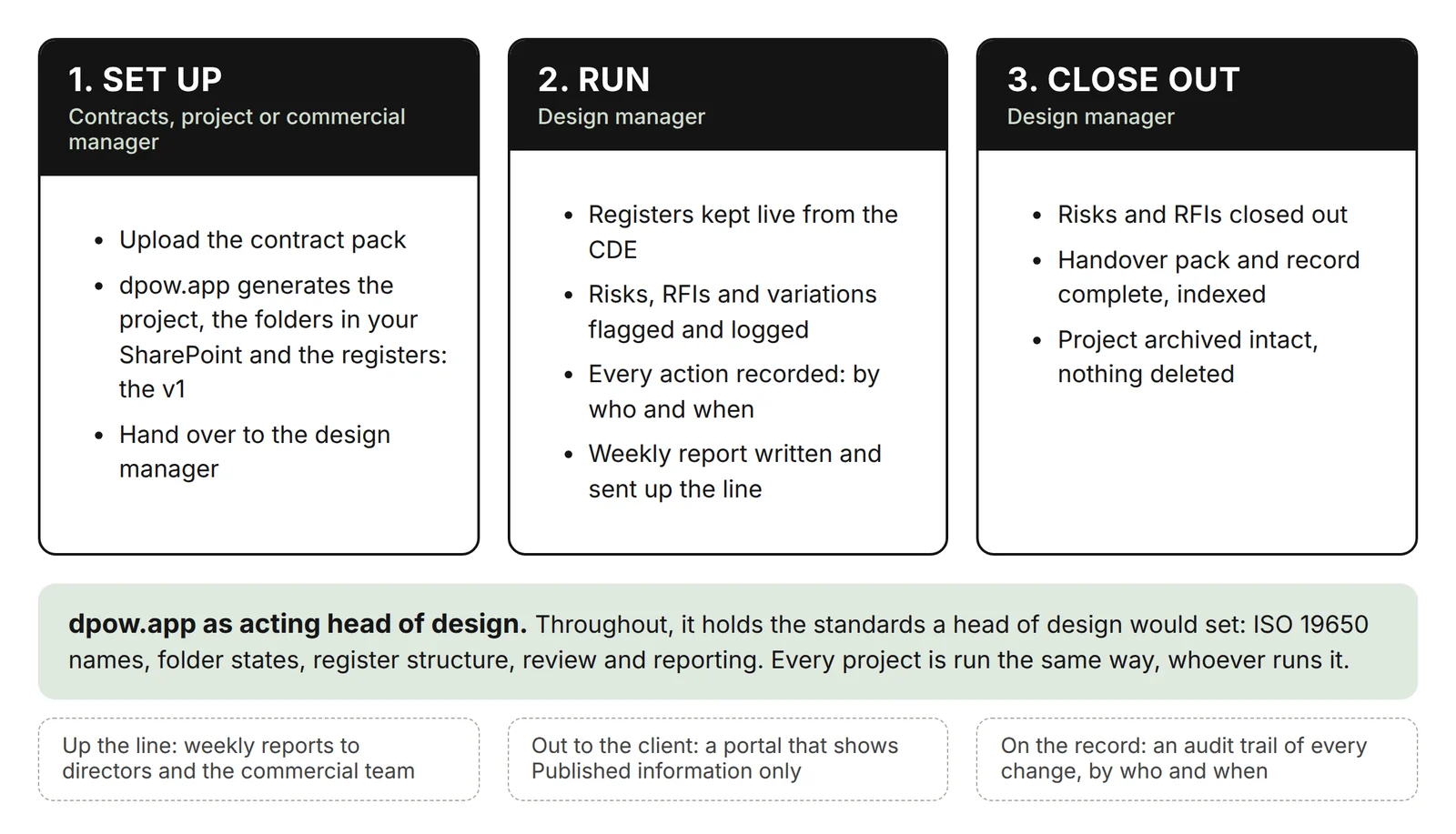
dpow.app runs on your own Microsoft 365 and SharePoint, so your files stay in your own tenancy. It does the producing and the record-keeping; your people make the decisions. A project runs in three stages.
Set up: the v1
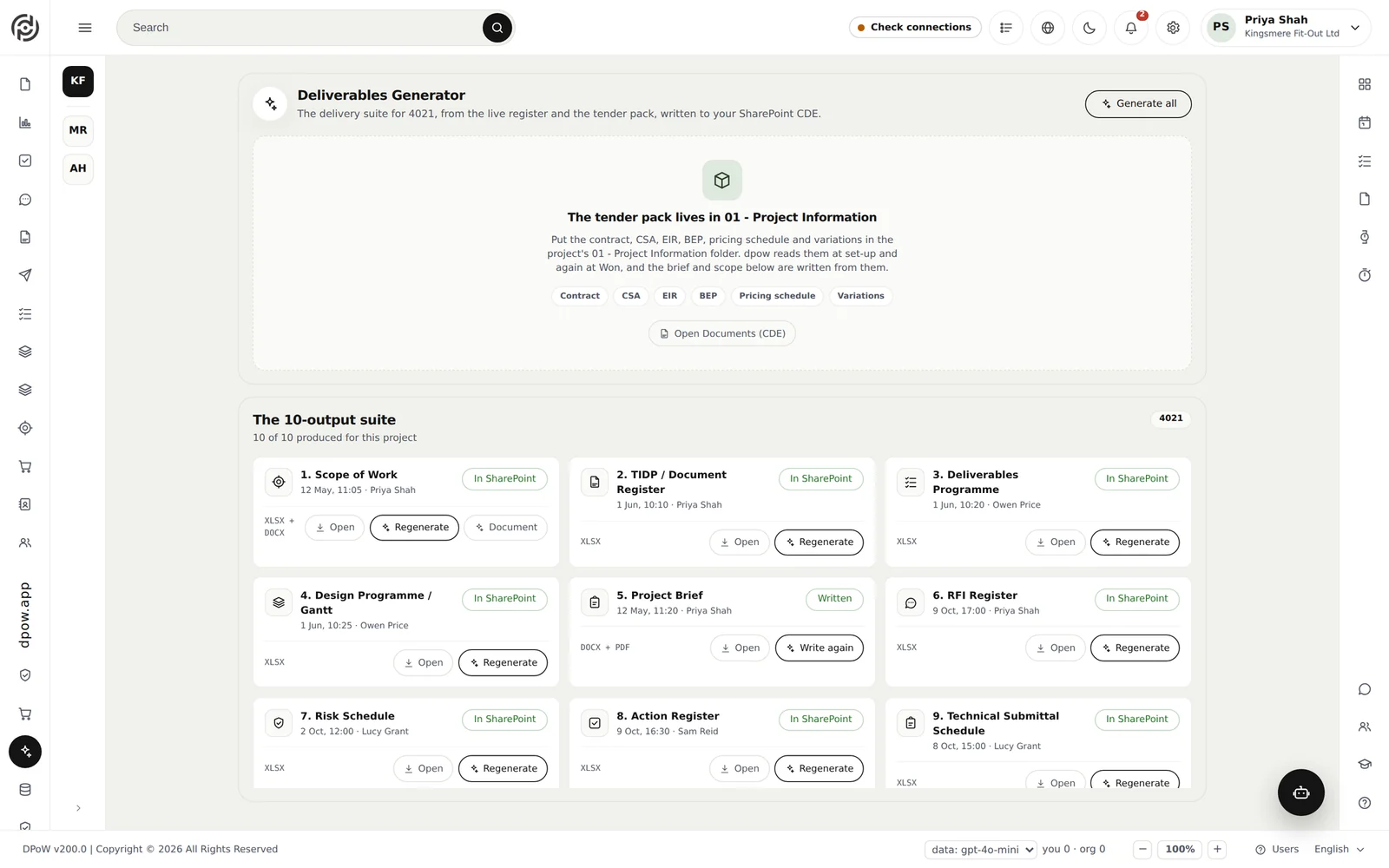
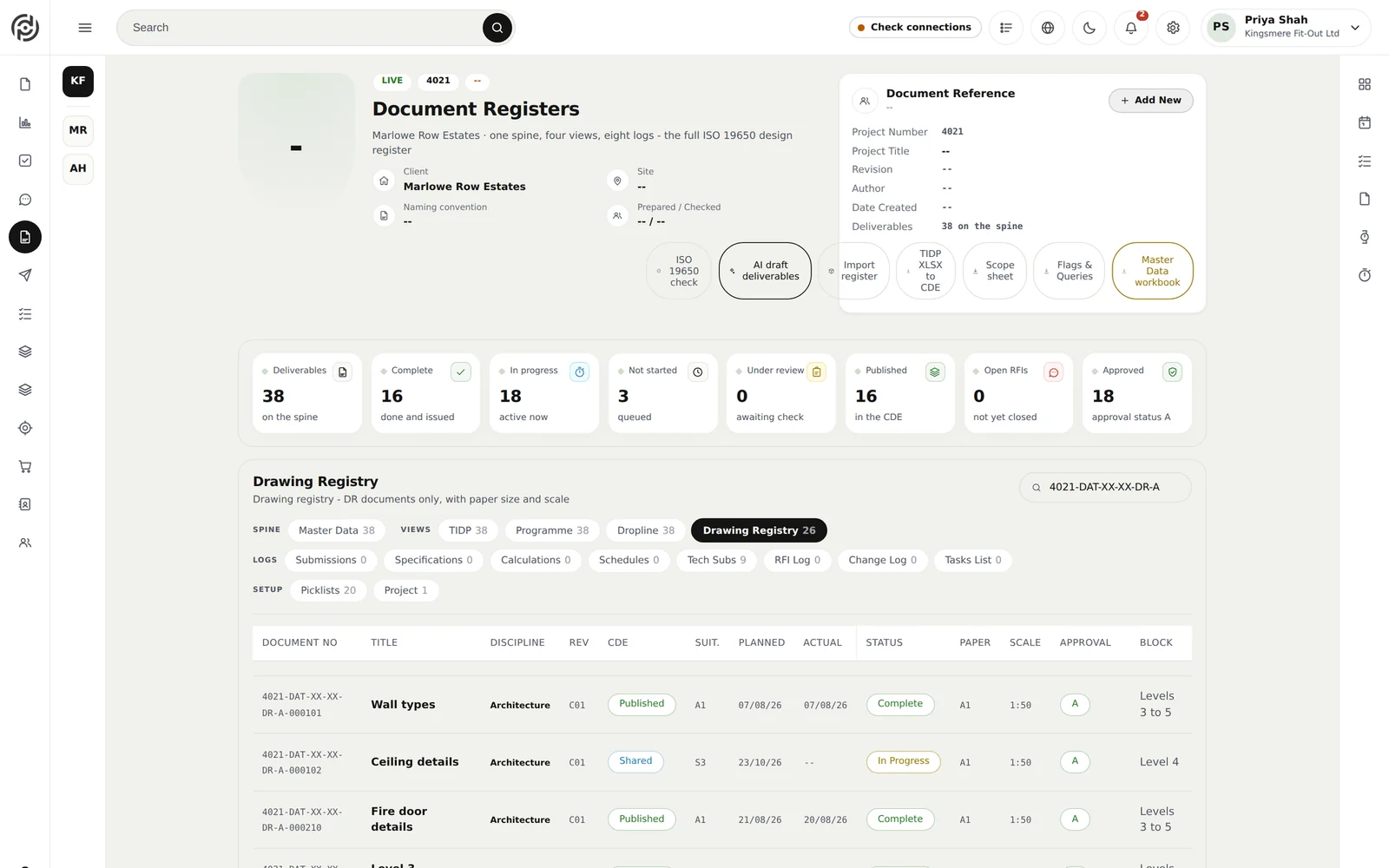
A contracts, project or commercial manager uploads the contract pack. dpow.app generates the project, builds the folder structure in your SharePoint and creates the registers: scope, TIDP, programmes, brief, drawing register, RFI, risk and variation logs. This first version, the v1, is in our experience what takes longest by hand. It is then handed to the design manager.
Run: to handover
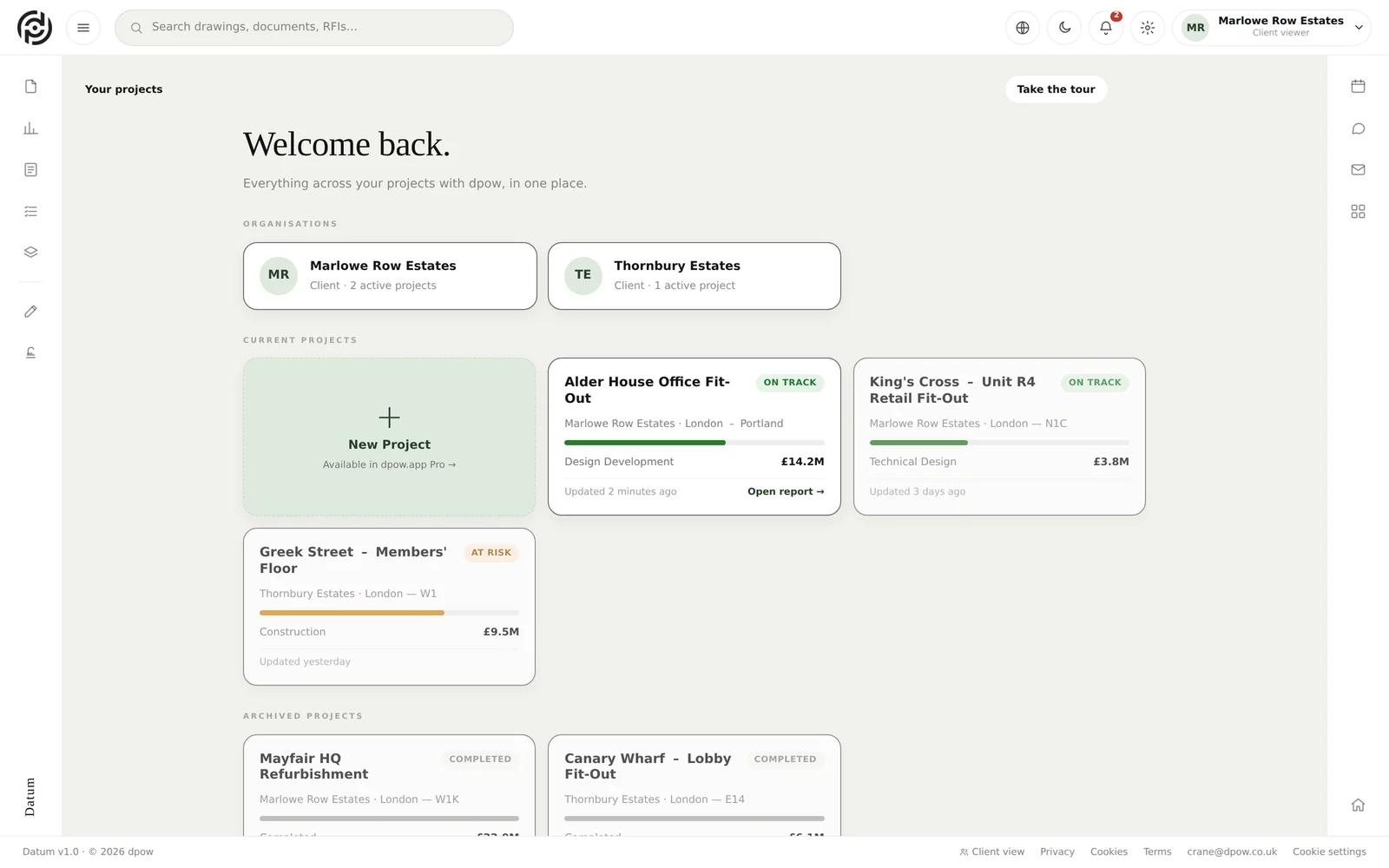
The design manager runs the project from the registers dpow.app keeps live. Risks, RFIs and variations are flagged and logged as they arise. Every action is recorded by who and when, so the audit trail builds itself. The weekly report is written from the live register for the design manager to review and send up the line, and the client sees a portal that is always current and shows Published information only.
Close out
Risks and RFIs are closed out against the log, the handover pack is assembled from a record built as the job ran, and the project is archived intact, with nothing deleted.
4. The time it gives back
We have not found published UK data on how long this work takes, so the figures below are our estimate, for a contractor delivering six projects a year, three live at once, each running for 26 weeks, with one design manager. We also show a cautious case at half our estimate, to show the result does not depend on our numbers being right.
| Stage | What dpow.app takes off the design manager | Our estimate, per project | Six projects |
|---|---|---|---|
| Set-up (the v1) | Building the project, folders, naming and registers by hand | 40 hours (one working week) | 240 h |
| Running | Keeping registers current, logging risks and variations, recording who and when, writing the weekly report | 1.5 hours a week for 26 weeks | 234 h |
| RFIs | Drafting, logging, linking to drawings and chasing | 30 RFIs, half an hour each | 90 h |
| Close-out | Closing risks and assembling the handover index | 8 hours | 48 h |
| Total a year | 612 h | ||
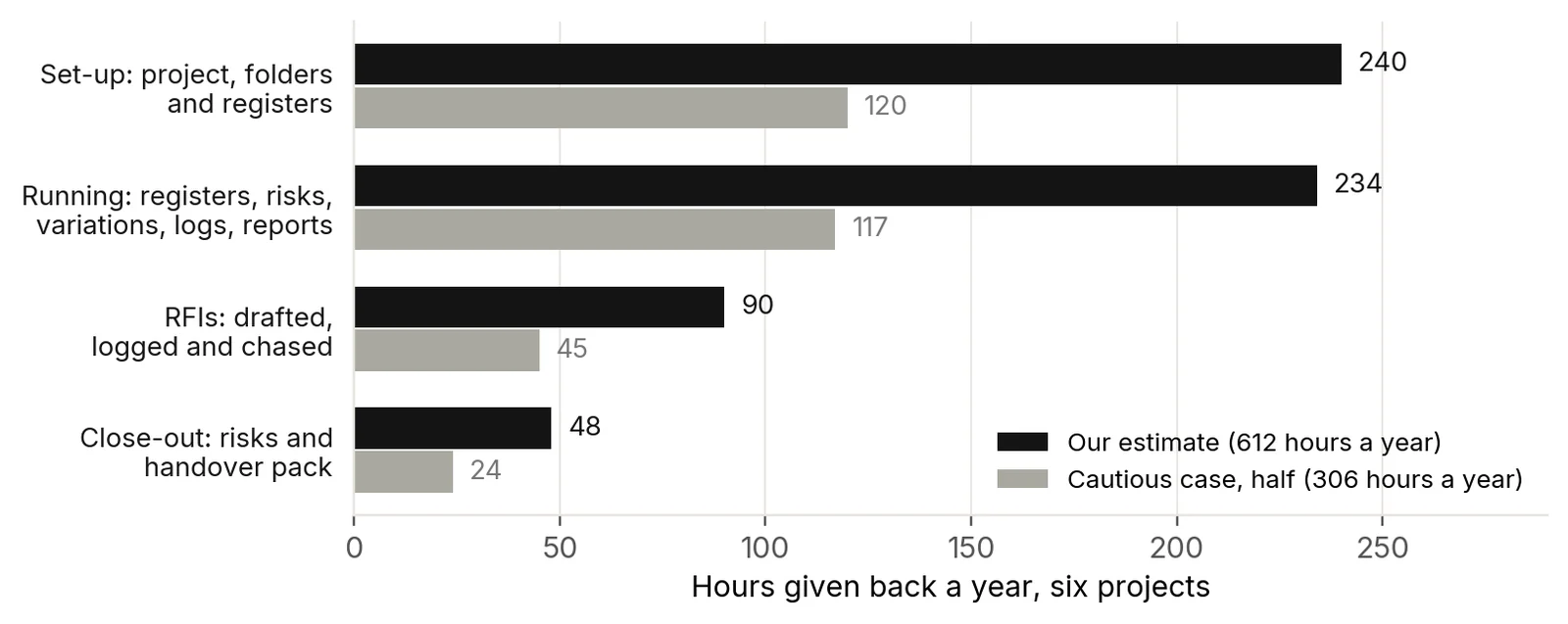
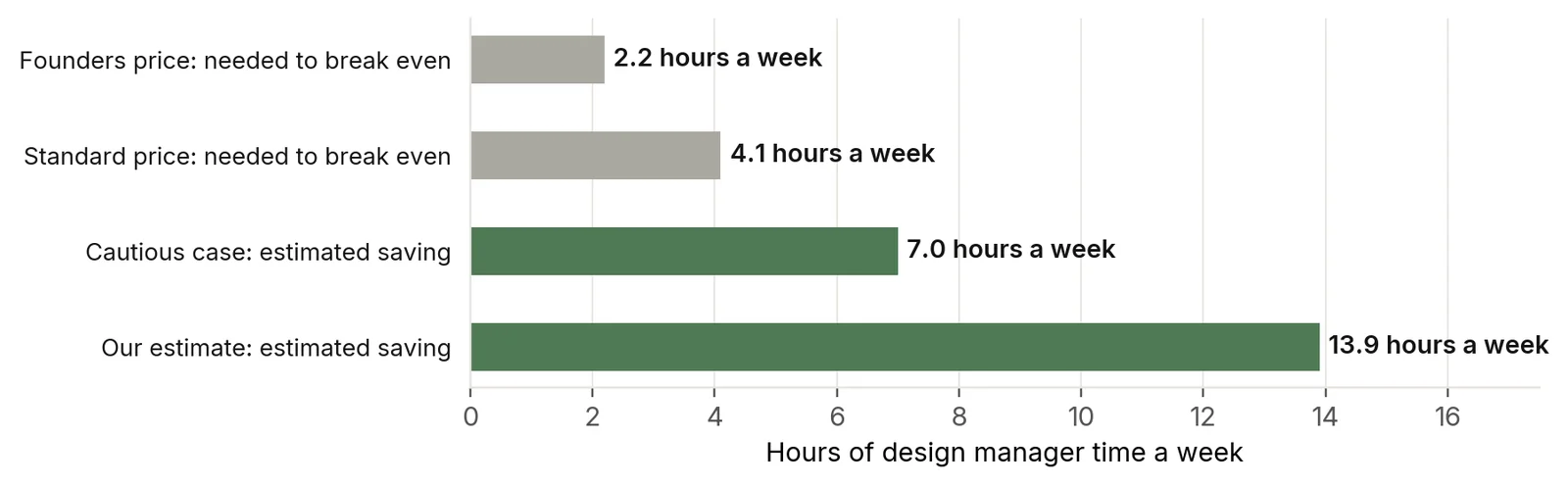
That is 37% of a 1,650-hour working year (37.5 hours over 44 working weeks), or about 13.9 hours, almost two days, a week. In the cautious case it is 306 hours, about one day a week.
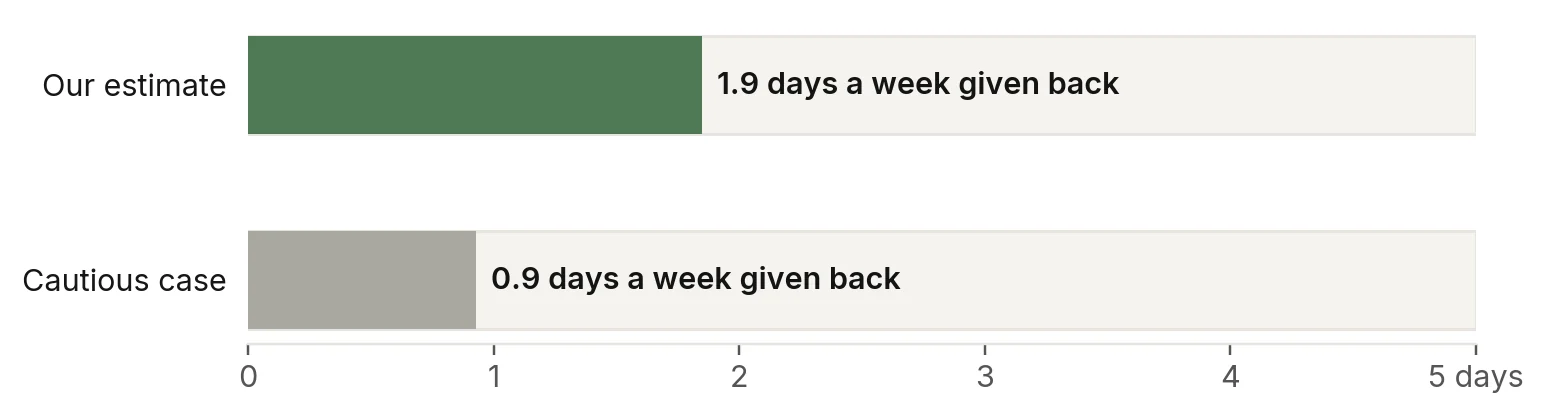
The point is not fewer people. It is what the same people can do with the time:
- More design. The time goes on coordination, reviews and the drawings themselves, which is where several of the causes GIRI lists can be addressed.
- Another project. Almost two days a week is capacity a growing business can use to take on more work without adding headcount.
- Fewer gaps. Work that slips when people are busy, such as the risk log, the variation record and the weekly report, is done the same way every week.
5. What the time is worth
Saved time is valued at what it costs to employ the design manager who would otherwise spend it: a salary of £55,000, inside the £44,000 to £65,000 range Glassdoor UK lists for design managers (accessed October 2026), plus the employer costs set by government.
| Design manager | |
|---|---|
| Salary (Glassdoor UK range £44,000 to £65,000) | £55,000 |
| Employer National Insurance: 15% of salary above £5,000 (GOV.UK, 2026 to 2027) | £7,500 |
| Employer pension: 3% minimum of earnings between £6,240 and £50,270 (GOV.UK) | £1,321 |
| Employed cost a year | £63,821 |
| Cost of one hour (÷ 1,650 working hours, our estimate) | £38.68 |
No bonus, car, higher pension, training or overhead is included. Glassdoor's headline average for a "construction design manager" is lower, at £41,771: at that salary the hour costs £29.30, our estimate is worth £17,934 a year, the return at the Standard price is 2.6 times, and break-even rises to 5.3 hours a week.
Valued as time
At £38.68 an hour, our estimate of 612 hours is worth £23,672 a year; the cautious case is worth £11,836. This is the figure used for the return below.
Valued as capacity
If the time is used to take on one more project, the value is the profit on that project instead. For a £1.5 million project at the 3.33% average pre-tax margin of the top 20 specialists, that is about £50,000 of pre-tax profit. The project value is an example; we show it as potential and do not count it in the return.
Against hiring for capacity
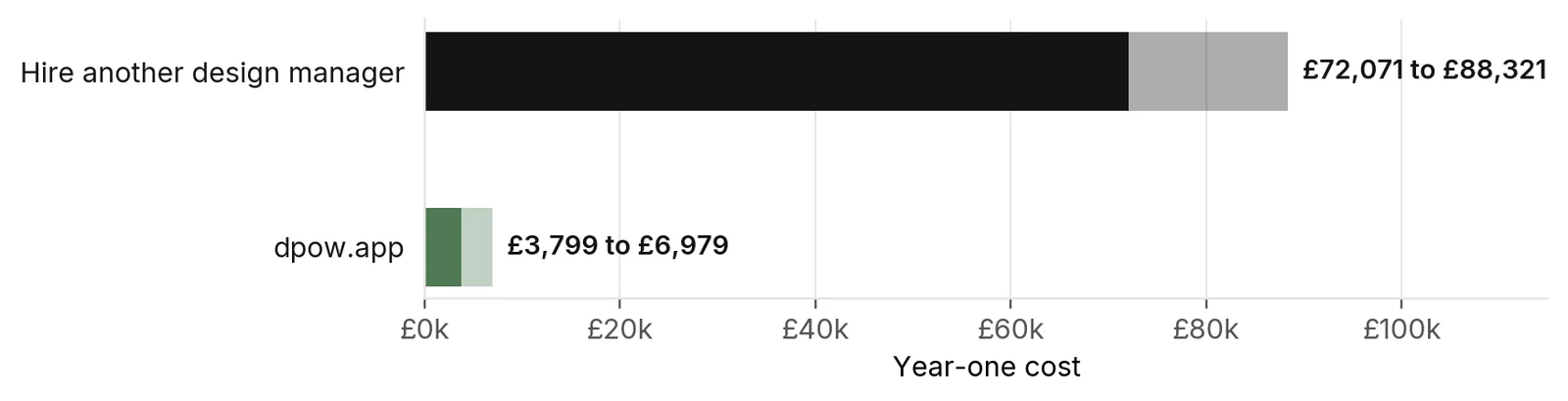
The usual way to add design capacity is to hire. A design manager on £55,000 to £65,000 costs £72,071 to £88,321 in year one, including employer costs and a recruitment fee of 15% to 20% of salary, the range Phoenix Gray Recruitment gives for project, contracts and M&E manager roles (2026).
Hiring and dpow.app are not either-or. A design manager you do hire runs every project on the same system from the first week.
6. Upscaling your team
dpow.app builds best practice into the way the work is done, so every level of the team works to the same standard. Glassdoor UK's pay ranges show the step between levels: £44,000 to £65,000 for a design manager and £59,000 to £84,000 for a senior design manager.
| Who | Without a common system | With dpow.app |
|---|---|---|
| Junior or assistant design manager | Learns the standard by trial and error, from whoever is nearest | Learns ISO 19650 by working inside a structure that already follows it |
| Mid-weight design manager | Runs their own system, with gaps when busy | Produces the complete registers, logged risks and consistent reports expected of a senior |
| Senior design manager | Spends days a week on administration | Runs more projects and spends the time on design and coordination |
| Contracts, project or commercial manager | Waits for a design manager before the design side can start | Sets up the design portion from the contract pack, then hands it over |
| Directors | Three managers, three formats, no single view | The same weekly report from every project, sent up the line |
dpow.app does not change anyone's grade or judgement. It removes the difference in how the paperwork is done, so the difference between people shows in the design work instead.
7. Acting head of design
A head of design sets the standards a business works to: how projects are set up, how files are named and stored, what the registers hold, how risks and changes are recorded, and what gets reported. Contractor head of design roles advertised in September 2026 offered £80,000 to £100,000 (CV-Library, HVAC, London) and £100,000 to £110,000 (CIOB Jobs, main contractor, Essex).
Once dpow.app is running, it holds those standards and applies them to every project. A contracts, project or commercial manager can set up the design portion of a new project; the design manager then manages it to handover, sending reports up the line and closing out the risks, to best practice. For a business not yet ready to carry a head of design salary, it gives you the standards a head of design would set; the decisions stay with your people. For a business that has one, it gives them a system their team follows by default.
8. The return
| Six projects a year | Our estimate, Standard | Our estimate, Founders | Cautious, Standard | Cautious, Founders |
|---|---|---|---|---|
| Hours given back a year | 612 | 612 | 306 | 306 |
| Value at £38.68 an hour | £23,672 | £23,672 | £11,836 | £11,836 |
| Year-one cost (price plus 16 hours onboarding, our estimate) | £6,979 | £3,799 | £6,979 | £3,799 |
| Return on year-one cost | 3.4x | 6.2x | 1.7x | 3.1x |
| Payback | 15.3 weeks | 8.3 weeks | 30.7 weeks | 16.7 weeks |
dpow.app prices: Standard £6,360 a year per organisation including one Editor; Founders £3,180 a year with three Editors, twenty places. The return counts time only: the potential extra project is not included.
Break-even
The break-even does not depend on our estimates of time saved. At the Standard price, dpow.app must save 180 hours a year, or 4.1 hours a week: about half a day. At the founder price it is 98 hours a year, or 2.2 hours a week. Per project, that is 30.1 hours (Standard) or 16.4 hours (Founders), less than the time we estimate the set-up alone takes by hand.
9. Work out your own break-even
Put in your own design manager's salary and the hours they spend each week on registers, logs, reports and chasing. The sums are the same ones used above.
If the hours they spend today are more than the hours it must save, dpow.app pays for itself on running the registers alone, before set-up, RFIs, close-out or avoided error are counted.
10. The record
Because every action is logged by who and when, dpow.app keeps a full audit trail on every project: what was issued, to whom, at which revision; what was asked and when it was answered; what change was agreed and before which work.
On a higher-risk building, the law asks for a record of this kind. GOV.UK defines a higher-risk building as one at least 18 metres or seven storeys high with at least two residential units, or a hospital or care home. Its guidance on the golden thread describes a digital record kept secure, with version control so users can see any changes, and requires duty holders to keep it up to date. dpow.app keeps that kind of record as a matter of course, whatever the building. It does not make a project compliant; the duty holders remain responsible.
11. What this analysis does not claim
- dpow.app does not replace a design manager or a head of design. It makes them faster and gives the business one way of working. Judgement and sign-off stay with your people.
- dpow.app does not make anyone compliant. ISO 19650 is best practice; dpow.app produces information to it and keeps the record.
- The hours are our estimates until measured. Founder projects will log set-up and weekly administration time before and after, and this analysis will be updated with the measured figures.
- Saved time is not cash until it is used: on design, on another project, or in place of overtime or a hire.
- Not counted at all: fewer errors and disputes, faster client sign-off from the live portal, the value of a complete archive, and being the subcontractor a main contractor wants back.
How the figures are calculated
| Figure | Calculation |
|---|---|
| Employed cost | Salary + 15% × (salary − £5,000) + 3% × (salary up to £50,270, less £6,240) |
| Cost of one hour | Employed cost ÷ 1,650 (our estimate: 37.5 hours × 44 weeks) |
| Set-up hours | 40 hours × 6 projects = 240 |
| Running hours | 1.5 hours a week × 26 weeks × 6 projects = 234 |
| RFI hours | 30 RFIs × 0.5 hours × 6 projects = 90 |
| Close-out hours | 8 hours × 6 projects = 48 |
| Hours a week | Total hours ÷ 44 working weeks |
| Cautious case | Half of each line above |
| Value of time | Hours × cost of one hour |
| Year-one cost | Price + 16 hours × cost of one hour |
| Return on cost | Value of time ÷ year-one cost |
| Payback in weeks | Year-one cost ÷ (value of time ÷ 52), assuming the benefit arrives evenly |
| Break-even hours | Year-one cost ÷ cost of one hour |
| Extra project (potential) | £1.5m × 3.33% = £49,950 pre-tax profit; not counted in the return |
Sources
- Get It Right Initiative, Strategy for Change (revised June 2019): measured direct cost of avoidable error about 5% of project value (about £5bn a year); 10% to 25% including unmeasured and indirect costs; the ten root causes of error.
- The Construction Index, Top 100 construction companies 2026: combined turnover £81bn, pre-tax profit £2.3bn, average margin just over 3%; top 20 specialists £6.7bn at 3.33%.
- King's College London with the Adjudication Society, Construction Adjudication in the United Kingdom (November 2024): record 2,264 referrals.
- Glassdoor UK, construction design manager salaries (accessed October 2026).
- GOV.UK, rates and thresholds for employers 2026 to 2027, and workplace pensions.
- Phoenix Gray Recruitment, construction recruitment costs (2026): placement fees of 15% to 20% of first-year salary.
- CV-Library, Head of Design and Sustainability (HVAC), London, posted 17 September 2026; CIOB Jobs, Head of Design, Essex, posted 29 September 2026.
- GOV.UK, Keeping information about a higher-risk building: the golden thread.
All sources accessed 2 and 3 October 2026. dpow.app prices are dpow's own.
Twenty founding places at half price
£3,180 a year with three Editors, and your first project set up with you. Standard is £6,360 a year with one Editor.
Claim a founding place